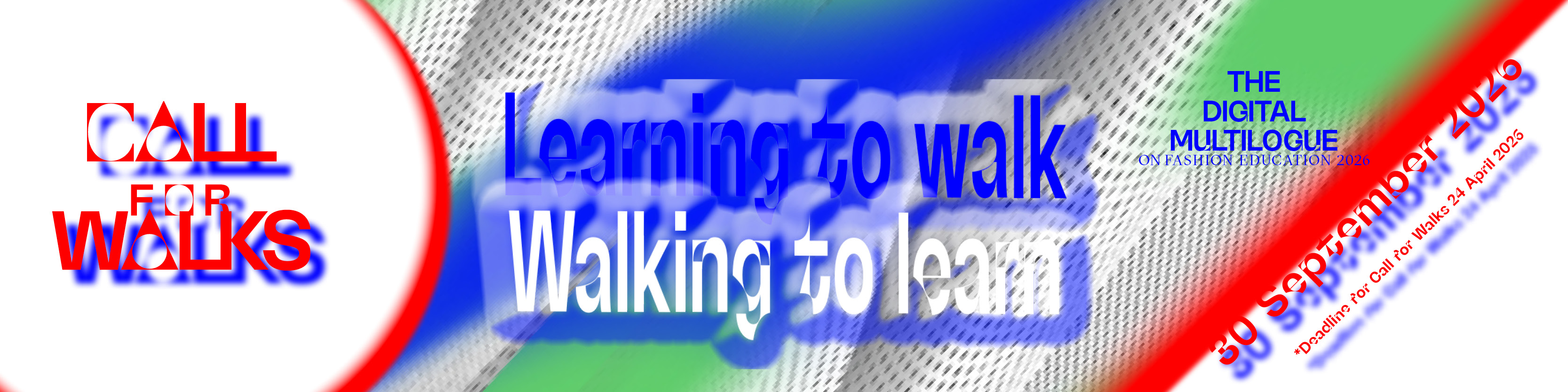

Part 2 - The Walking Multilogue:
24 hours of local-global walk-learning30 September 2026
Call for Walks
See details below or download pdf HERE.After Learning to Walk, the incredibly enriching and inspiring first part of this Multilogue on walk-learning fashion, we look forward to Walking to Learn –
to 24 hours of local-global walk-learning.
All the World is a classroom.
Where do we learn fashion? In our grandmother’s lap, in the street, the club, the market, everywhere. Professional fashion learning used to take place in workshops and studios, ateliers and factories. It still does. Yet, from the 19th century it also moved into colleges and universities. Fashion education became increasingly specialized, institutionalized and intellectualized. As a result, we see a dualism between informal and professional fashion learning, and between vocational and tertiary education. One seems more valid than the other. One seems more worth than the other. There are severe hierarchies within fashion education that mirror and codetermine those in the professional field. Hierarchies between sites of learning, qualifications, the value of professions, the value of subsequent work, between intellectual and manual labour, between the worth of human beings and human lives. Global hierarchies and local hierarchies. Fashion education has increasingly become inaccessible. Increasingly distinctive, discriminatory, disembodied – disconnected from the everyday.
‘Let us walk […] and envision the learning environment as an emergent and
adaptable opportunity for connection and wonder.’
adaptable opportunity for connection and wonder.’
Beavington, Lee (2021) ‘Walking Pedagogy for Science Education and More-Than-Human Connection’ in: Journal of the Canadian Association for Curriculum Studies (JCACS). Vol. 18, No. 2, p. 163.
Let us explore walking for learning. Walking, the free and open activity we all do every day – if not in body, then in mind. Walking, not as a neutral activity, equally determined by gender, class, race, physical ability, but walking as a call to action.
Together let us explore walking to decentralize and dehierarchise fashion learning.
‘In an era of complex social and political issues – such as climate change, capitalism, and forced migration, to name a few – there is an increasing demand for public and
community action. Further, academics continue to grapple with ways to present research findings to non-academic audiences, while marginalized and oppressed people take up ways to transform and decolonize social and political space and institutions. To this end, walking is an ethical and political call to action.’
Springgray, Stephanie & Truman, Sarah E. (2019) ‘Walking in/as Publics: Editors Introduction’
in: Journal of Public Pedagogies. No. 4, p. 2
community action. Further, academics continue to grapple with ways to present research findings to non-academic audiences, while marginalized and oppressed people take up ways to transform and decolonize social and political space and institutions. To this end, walking is an ethical and political call to action.’
Springgray, Stephanie & Truman, Sarah E. (2019) ‘Walking in/as Publics: Editors Introduction’
in: Journal of Public Pedagogies. No. 4, p. 2
Walking to unlearn. Walking to learn.
Walking to wonder.
Walking together.
‘You’ll never walk alone’
Gerry and the Pacemakers, 1963
participation: free & open, registration required – all welcome!
Registration opens 24 June 2026 for online participation, local in-person participation organised by walking facilitators.
CONTRIBUTION
All the world is a classroom. Let us walk-learn together. We invite different walking action formats:
LIVE – LOCAL
Live local walking action, streamed globally.
Hybrid local & online participation.
• livestreams organized by respective local curators/guides, links published in conference program
• online participation unlimited and free
• local registration required & organized by respective facilitators
LIVE – GLOBAL
Live guided online walking action, streamed globally that can be followed individually or collectively wherever we are in the world.
PRERECORDED – LOCAL
Prerecorded walking action, streamed globally with live reflection & interaction.
• prerecord a walking action and facilitate a reflection/ interaction during the screening
Walking actions might include:
• theme-based walks rooted in local practices and knowledges
• celebrations & showcases of local fashion cultures, communities, histories, people and places: introduction the unknown, unusual, unofficial, undervalued, unrecognised – to a global audience
• experiences of local tastes, sounds and sensations
Please consider collaborative formats, join people & places, cultures & contexts, subjects & seasons, time zones & institutions, experiences & education, materials & methods for walk-learning fashion
TIMELINE
24 April 2026
Notifications of accepted proposals30 April 2026
Publication of program24 June 2026
The Digital Multilogue on Fashion Education 2026Walking to Learn
30 September 2026
Selected walks
will be scheduled for 24 consecutive hours across different time zones
on the 30 September 2026
will be scheduled for 24 consecutive hours across different time zones
on the 30 September 2026
DETAILS FOR CONTRIBUTION
Please submit the following
HERE
until 24 April 2026
• TITLE
• three KEYWORDS
• LOCATION
• walking FORMAT (Live-Local, Live-Global, Prerecorded-Local)
• TIME: please suggest a convenient time for your location
• DURATION: how long will the walking action last?
• LANGUAGE: all languages welcome – participants can use Zoom Real-Time-Translation to access all talks
• three KEYWORDS
• LOCATION
• walking FORMAT (Live-Local, Live-Global, Prerecorded-Local)
• TIME: please suggest a convenient time for your location
• DURATION: how long will the walking action last?
• LANGUAGE: all languages welcome – participants can use Zoom Real-Time-Translation to access all talks
• CONCEPT: abstract (250 words) with explanation of walking format – what will be experienced and learnt through walking, potential collaborations, and possible activities for online audience
• a basic MAP of proposed walk (hand-drawn, marked in online map…)
• KEY IMAGE of walk (with credit, to publicise walk)
• FACILITATOR/S’ INFORMATION: name, location, job title, affiliation, contact details, 100-word bio blurb
• a basic MAP of proposed walk (hand-drawn, marked in online map…)
• KEY IMAGE of walk (with credit, to publicise walk)
• FACILITATOR/S’ INFORMATION: name, location, job title, affiliation, contact details, 100-word bio blurb
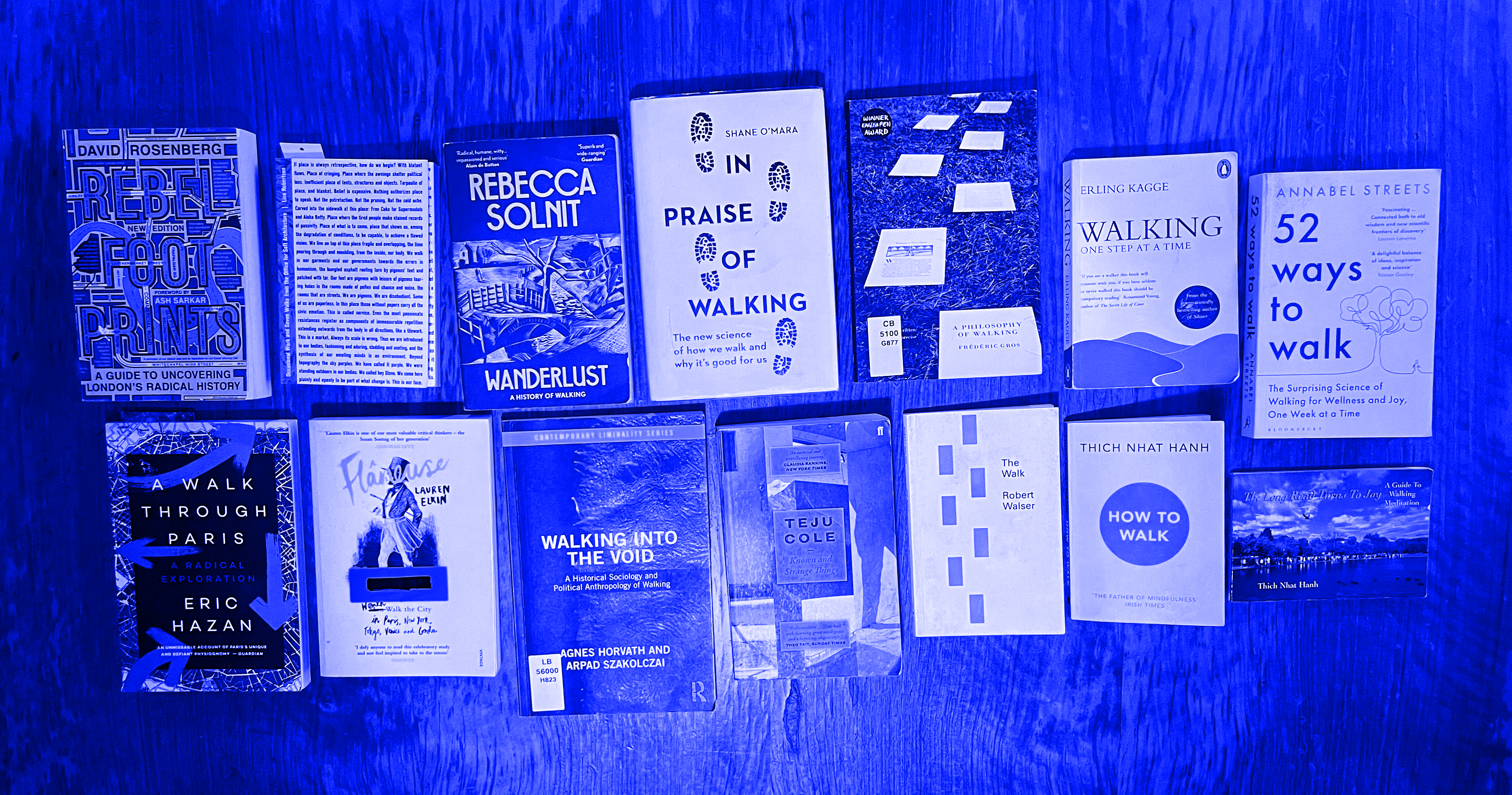
Interested in further readings?
Visit the Learning to Walk / Walking to Learn – sources & resources online readling list

What is the Digital Multilogue on Fashion Education anyway?
The Digital Multilogue on Fashion Education wants to create connections and actions within and across different fashion learning cultures and contexts. It was founded in 2019 as a participatory and outcome-oriented space and a series of conferences focused on the learning and teaching of fashion. It aims to explore and illustrate the diversity and complexity of the field and the practices of fashion education, and to foster a greater understanding of its pasts, presents and futures – methods, values and didactic, pedagogic and epistemological questions – creating a global exchange to inspire mutual learning, collaborative research and shared action.
When is the Multilogue 2026 taking place?
30 September 2026. Please save the date.
The Digital Multilogue on Fashion Education wants to create connections and actions within and across different fashion learning cultures and contexts. It was founded in 2019 as a participatory and outcome-oriented space and a series of conferences focused on the learning and teaching of fashion. It aims to explore and illustrate the diversity and complexity of the field and the practices of fashion education, and to foster a greater understanding of its pasts, presents and futures – methods, values and didactic, pedagogic and epistemological questions – creating a global exchange to inspire mutual learning, collaborative research and shared action.
When is the Multilogue 2026 taking place?
30 September 2026. Please save the date.
What is it about and why?
The two-part edition of The Digital Multilogue on Fashion Education 2025/2026 is about: Learning to Walk, Walking to Learn.
Where is it happening: online / hybrid / in-person?
People are called to come together online to connect with global fashion learning communities. Anyway, everyone is invited to meet locally with friends and peers, joining the global community online.
Who could participate?
Everyone. The Multilogues are always open-access and free for all. As should all education be! And, as Everyone is a fashion learner.
I have more questions, who can I ask?
Please don’t hesitate to contact us on:
multilogue@fashioneducation.org
The two-part edition of The Digital Multilogue on Fashion Education 2025/2026 is about: Learning to Walk, Walking to Learn.
Where is it happening: online / hybrid / in-person?
People are called to come together online to connect with global fashion learning communities. Anyway, everyone is invited to meet locally with friends and peers, joining the global community online.
Who could participate?
Everyone. The Multilogues are always open-access and free for all. As should all education be! And, as Everyone is a fashion learner.
I have more questions, who can I ask?
Please don’t hesitate to contact us on:
multilogue@fashioneducation.org
The Digital Multilogue on Fashion Education wants to create connections and actions within and across different fashion learning cultures and contexts. It was founded in 2019 as a participatory and outcome-oriented space and a series of conferences focused on the learning and teaching of fashion. It aims to explore and illustrate the diversity and complexity of the field and the practices of fashion education, and to foster a greater understanding of its pasts, presents and futures – methods, values and didactic, pedagogic and epistemological questions – creating a global exchange to inspire mutual learning, collaborative research and shared action.
The Multilogues are organized by Franziska Schreiber & Dr. Renate Stauss, who are brought together and driven by their love for making and wearing fashion, for learning and thinking through fashion, and their belief in its connective, educational and transformative potential.
The Multilogues are organized by Franziska Schreiber & Dr. Renate Stauss, who are brought together and driven by their love for making and wearing fashion, for learning and thinking through fashion, and their belief in its connective, educational and transformative potential.
• CALL FOR WALKS OUT NOW • THE DIGITAL MULTILOGUE ON FASHION EDUCATION • 30 SEPTEMBER 2025´6 • PART 2 - THE WALKING MULTILOGUE ON DECENTRALISING & DEHIERARCHISING LEARNING & TEACHING FASHION
ORGANISERS

Dr. Renate Stauss is Assistant Professor of Fashion Studies at The American University of Paris in the Department of Communication, Media and Culture. She is also a lecturer at the Berlin University of the Arts.

Franziska Schreiber is a fashion designer
and currently holds a professorship for „fashion I body I digitality“ at the
Berlin University of the Arts.
FASHION IS A GREAT TEACHER – THE FASHION EDUCATION PODCAST
Fashion is a great teacher because it provides a fantastic lens to learn about the world and its people, about history, politics and culture. Join Renate Stauss and Franziska Schreiber, to discover the most inspiring voices in fashion education, their take on the how and why of learning and teaching fashion, their doubts and hopes, their lessons from fashion.

MULTILOGUE MOMENTS
This series of Fashion is a great teacher brings you Provocations and a Choir of Ideas from The Digital Multilogue on Fashion Education 2023: De-Fashioning Education; a Critical Thinking and Making Conference. We invited speakers from every continent to share their concerns, questions and ideas: Anjana Das, Mayank Mansingh Kaul, Sandra Niessen, Sunny Dolat, Otto von Busch, and Christina H. Moon, as they navigate the complexities of de-fashioning education, cultural inclusivity, sustainability, and transformative partnerships. This series invites listeners to join a global community rethinking fashion education for essential de-growth and diverse, interconnected futures.
Listen to the latest episode!
MULTILOGUE MOMENTS
Season 2 / Episode
Ben Barry on ‘on Unpicking jackets, instating justice and remembering the joy of fashion'
In this episode you meet Ben Barry - fashion educator, designer-researcher and academic leader who is devoted to equity, inclusion and social justice in fashion education and the fashion industry.
Fashion is a great teacher talks to him about unpicking his suit jackets and inherent notions of masculinity, transformative educational experiences and using ones’ body to navigate the complexities of institutional change. Finding liberatory pockets and fashion utopia in everyday clothing. And how it all started with him playing in his grandmother’s closet.
THE FASHION EDUCATORS’ WORLD MAP
Come together! - towards a collaborative community of fashion educators. Join this global community mapping, inaugurated at The Digital Multilogue on Fashion Education 2020
Please join on Padlet!

FASHIONING EDUCATION
Fashioning education is a collaborative research initiative to open, facilitate and formalise the debate on fashion education against the backdrop of global social transformations.
Project website
© 2022 Fashion is a great teacher
Franziska Schreiber & Renate Stauss GbR
Lychener Str. 82
10437 Berlin
design & implementation
Gina Mönch, Anastasia Almosova
We make every effort to keep the information on our Web site current. But we do not accept responsibility for the topicality,correctness and completeness of the information provided on the website. This also applies to the content of external websites linked to this site via direct and indirect hyperlinks. The content on this website is protected by copyright. The copying and/or distribution of the content of this website is only allowed in the case of prior, written permission.